
Download the designed pdf version of the Moderator's 2026 Waitangi message here.
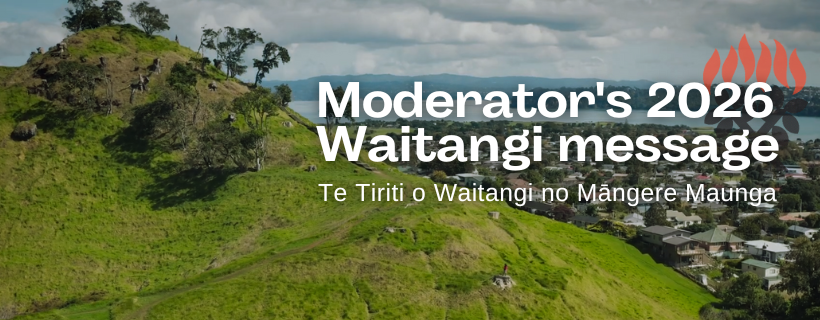
Te Tiriti o Waitangi no Māngere Maunga
On Auckland Anniversary day just past, I went for a walk from where I was staying to the top of Māngere Maunga. I sat for about two hours on the highest point to chill out, think about some things and pray. The immediate emotion - for those who lost their lives in the most tragic of circumstances in the landslip at Mt Maunganui in Tauranga a few days before - came like a lament. A terrible tragedy felt across the nation. Until all the bodies are recovered that lament will continue to be followed by coming to terms with the tragedy and why it happened. Pray with me for the grieving families.
The pre-colonial history of Māngere Mountain and the area around it is worth researching. It has been a rich and bountiful place since being first settled by Māori as early as the 1200s.
From the time of European arrival its history has a similar script to many places in Auckland and the Waikato. Despite the Treaty of Waitangi, Māori land was invaded, war was raged and great tracts of land were taken or confiscated by the colonial government of the time.
I well remember from far away in Southland being disturbed and angry with what happened at Bastion Point, about 20kms from Māngere Mountain. Following the Waikato Wars the mountain and surrounding fertile land was confiscated because its strategic location with its Pa was seen as a threat. The land became settler farms and the mountain itself was made into a public reserve. Through a treaty settlement in 2014, Māngere Maunga is owned by the Crown and administered through the Tūpuna Maunga o Tāmaki Makaurau Authority. The public have access.
Sitting at the summit presents a stunning scene. As far as you can see, you see city in every direction with the interludes of harbours and waterways.
Then there is the portent of the present debates over the relevancy and meaning of the Treaty in 2026. In the scene I set before you is the Maunga itself, a centre for a living culture going back at least 45 generations. Then literally butted up against the base of the mountain where the extensive kumara gardens were for centuries, the modern houses of Māngere. Roll a rock down and it would go through a back fence. I looked at the scene for a long time with this taunga of a place. Today 186 years after Te Tiriti o Waitangi was first signed, the city, a rock roll away, whose founding and expansion largely, if not completely, ignored the Treaty.
Sitting on the highest point of Māngere Mountain the Moderator of the Presbyterian Church of Aotearoa New Zealand remembered in brief what the Church has said and enacted in response the Treaty of Waitangi. PCANZ interprets the Treaty not just as a legal document, but as a "covenant" or sacred promise between the Crown and Māori. We formally recognise a bicultural partnership between Te Aka Puahou and the members of the Church and its courts. The Presbyterian Church actively observes Waitangi Day, with representatives participating in events at Waitangi. As an ongoing response to the Treaty, anti-racism and equal justice for all has become a mark of our Christian witness. Kia tae mai tou rangatira-tanga. Kia meatia tau e pai ai ki runga ki te whenua, kia rite ano ki to te rangi. Praying for a present and future where Tangata Whenua and Tangata Tiriti live together in peace and mutual respect.
However, the recent diatribes and debates about the Treaty through academic, political and particular ideologies on both sides of the Treaty debate are not conducive to a transformed society happening soon. Some say it is all helpful debate. Some say it is ultimately destructive as wrong power flexes itself. From a Pākehā perspective Tino Rangatiratunga lights a fire of mistrust that smolders hot in many. How can self-governance by Māori exist in a democratic society? That is one of the undercurrents of these times.
Thinking about the Treaty from Māngere Maunga, invited my grandchildren/mokopuna to be with me, figuratively speaking of course. There are quite a few of them. They haven't really experienced the full force of a broken and mistrusting secular world yet. Still "innocent" in many respects. I can see them all together on occasions, as happens, in real time. Doing things together, playing, laughing and talking as close families do. They share multiple lineages. As a group they are familiar with a number of languages. All have European descent, somewhere it is possible that great, great, great grandfathers fought against each other in world wars. A Jewish lineage with an ancient surname that was changed after World War 2 that takes them back to the time of Solomon’s Temple. And in that mix Tangata Whenua, carrying the Māori lineage of this land. When they are together and apart, none of that matters. Looking to their future I loath anything that makes their differences in ethnicity the basis of New Zealand society.
As a Presbyterian Church of Aotearoa New Zealand member, be praying and be vigilant that we will never be seduced by the words of an ideology that does not come from the teaching of Jesus and the Spirit he bestows on us all. Pray earnestly that as a Church we will not participate in the use of wrong power against anyone, through the right understanding of justice in action through word and deed. And the last word; the covenant aspect of Tiriti o Waitangi will only be fulfilled with the spiritual transformation of New Zealand. Pray for the Good News of the Gospel to change hearts and minds of every New Zealander.
Nā, tēnei te mau nei te whakapono, te tūmanako, te aroha, ēnei e toru; ko te mea nui rawa ia o ēnei ko te aroha.
Peter
Right Rev Peter Dunn
Moderator
Presbyterian Church of Aotearoa New Zealand
moderator@presbyterian.org.nz
* A note for those who switch off when they see Te Reo Māori in a piece of writing without an English translation provided… I suggest instead of feeling hard done by that you use a Māori to English translator, such as Google, for yourself. Learn a new skill. Repent of lazy!